The Default Parent: Why One Person Always Ends Up As The Manager

There's a specific kind of tired that has nothing to do with how much sleep you got.
It's the tired that comes from being the only person in your household who knows that the dentist appointment is Thursday, that the permission slip is due Friday, that you're almost out of milk, and that your partner has a work dinner next week which means you're handling pickup alone. Nobody assigned you this information. You just have it, the way you always have it, because at some point it became yours and nobody noticed it happening.
This is what it means to be the default parent. The default parent is the person in a household who holds the complete operational picture, the schedules, the upcoming deadlines, the things that need to happen before anyone else thinks to ask. Not necessarily the parent who does more visible work, but the one whose brain never fully stops. The one the school calls first. The one who, if they disappeared for a week, would leave the household genuinely unable to function.
Nobody chooses it. And very few people can explain, precisely, how it happened.
What Causes the Default Parent Dynamic?
It assembles itself, quietly, out of a thousand small moments.
One parent books the first pediatric appointment because the other is busy that day. One parent remembers the birthday gift for the party on Saturday. Another notices the winter coat doesn't fit anymore, and then orders the replacement, and then returns the one that didn't fit, and then remembers to move the new one to the front of the closet before the weather turns. Each moment is small. None of them feel like a decision. But over time they form a pattern, and the pattern becomes invisible, and the invisible becomes assumed.
By the time most default parents realize what's happened, the system has been running for years. They're not just doing more, they're carrying the entire operational picture of the household in their head, continuously, whether they want to or not.
Research from the University of Bath found that mothers carry roughly 70% of household cognitive labor regardless of income level, work status, or how equitable the relationship feels in other ways. But most default parents don't need a study to confirm it. They feel it every morning before they get out of bed.
The Invisible Labor of Information Transfer
It's not the knowing that's exhausting. It's the transferring.
Every time you say "the appointment is Thursday," you're doing a small act of labor that looks like nothing from the outside. Moving information from your head into someone else's. Confirming, again, that you were the one who had it.
The phrase that comes up most often when default parents describe this isn't "I do everything." It's "I shouldn't have to ask."
Seven words that contain the whole thing. Because the ask is the proof. Every time you have to remind someone, you're demonstrating that the information lived only in you, that without the transfer, it would have been lost. That's what accumulates. Not the tasks. The relentless confirmation that you are the single point of failure for your entire household.
There's a version of this that plays out dozens of times a week. A text from your partner asking whether soccer is today or tomorrow. A question about what time the thing starts. A request to remind them to call the school back. Each one is small. Together they form a kind of tax on your attention that never quite stops collecting.
Why Your Partner Keeps Asking "Just Tell Me What To Do"
Most partners in this situation aren't opting out. That's worth saying honestly, and without making it the center of the conversation.
A lot of non-default partners describe feeling genuinely lost at home, not indifferent, just without a clear view of what's needed or when. So they offer the thing that feels most useful: "just tell me what to do." Which sounds like help. But it puts the work of figuring out what to delegate, and how, and when, right back onto the person who is already running the whole operation. One partner wants to contribute. The other has to manage the contribution. The shape of the problem doesn't change, just who's visibly doing what.
Nobody built this on purpose. It assembled itself from moments where one person picked something up and the other didn't notice it needed picking up. Naming it clearly isn't about blame. It's about seeing how the system actually works, because you can't change something you can't see.
What Actually Helps: Sharing the Load Without Adding to It
Not a productivity system. Not a chore chart. The thing that consistently makes a difference is shared visibility, and a quiet shift in how responsibility gets held.
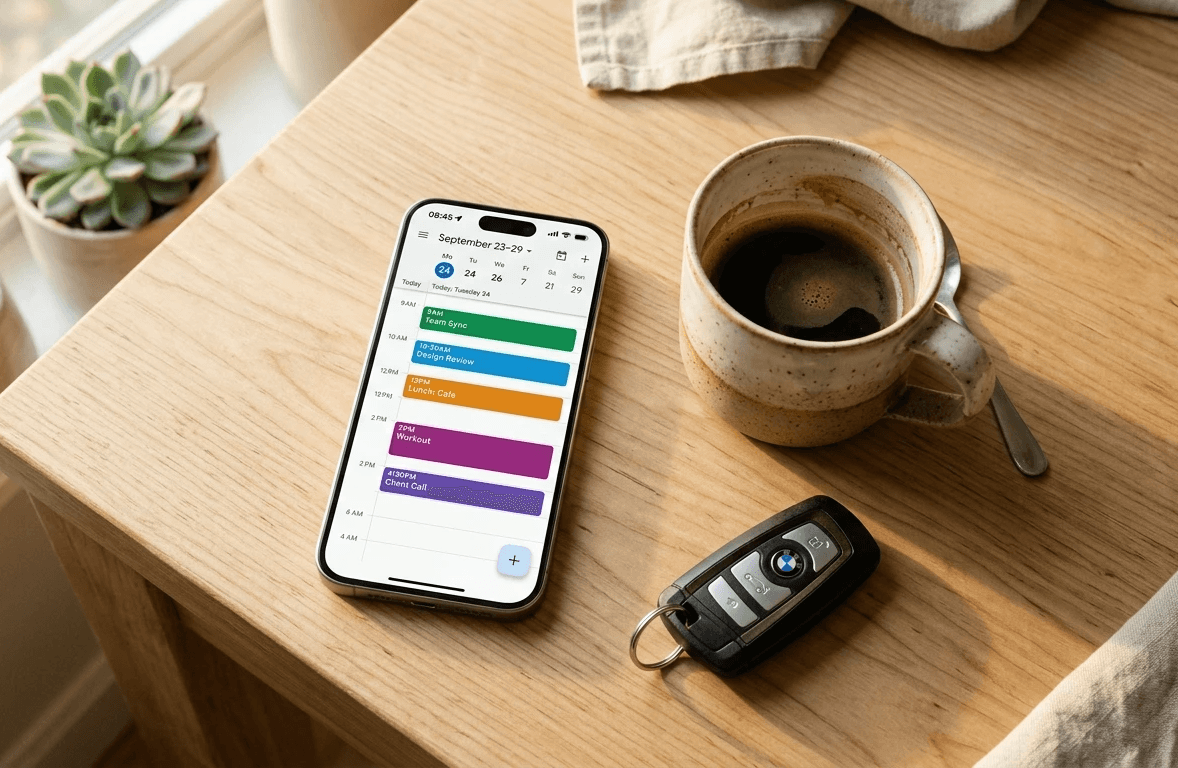
When both people can see what's coming, the calendar, what needs doing this week, what's already been handled, the information stops living in one person's head. The other person can act without being asked. That sounds unremarkable until you've lived the alternative long enough. Then it feels like something close to relief.
A regular weekly rhythm helps more than most people expect. Not a formal meeting, just a consistent moment where both people look at the same picture together. What's coming up this week. What needs to happen before Friday. Who's handling what. Fifteen minutes, once a week, has a disproportionate effect on how the rest of the week feels. Because it moves the knowing out of one person's head and into a shared space where both people can act on it.
The other shift worth making is the move from task delegation to genuine ownership. There's a difference between "can you take her to soccer this Saturday" and "soccer is yours, the schedule, the cleats, the water bottle, the carpool." The first is a handoff. The second is a transfer of the whole cognitive package. It's harder to establish, but it's the only thing that actually reduces the load rather than redistributing individual tasks while leaving the thinking in one place.
The tools that don't work are the ones only one person ends up using. Another app the default parent sets up, maintains, and reminds everyone else to check is just the same load in a slightly different container. For visibility to actually work, it has to be genuinely easy for both people, not just the organized one. If the second person doesn't find it immediately useful on their own terms, the system quietly collapses back onto one.
None of this closes the gap entirely. The default parent dynamic is, at its root, a relationship conversation that no calendar app can replace. But there is a meaningful difference between carrying the whole map alone and having somewhere both people can actually look. The first is exhausting. The second is at least a start.